


- Neurology
- 2026
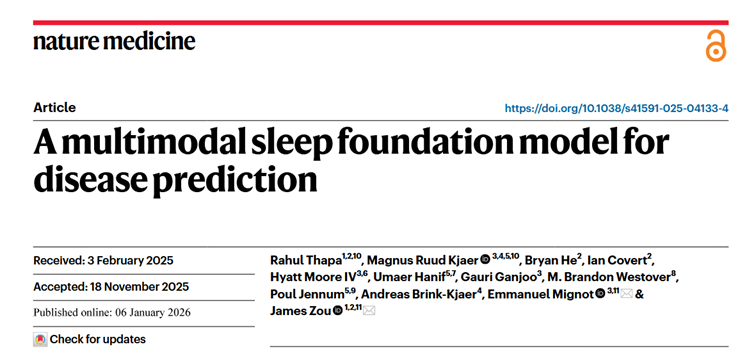
BIOSerenity contributes to a publication in Nature Medicine : A multimodal sleep foundation model for disease prediction
Estimated reading time: 2 minutes
Major advance in sleep medicine research
We are proud to begin 2026 with the publication of a research paper in Nature Medicine, resulting from a collaboration with Professor Emmanuel Mignot’s team at Stanford University. The study introduces a multimodal AI foundation model for automated disease prediction using polysomnography data, representing a major advance in sleep medicine research and AI-powered diagnostics.
When sleep has a lot to say
This study introduces a multimodal foundation model trained on large-scale polysomnography (PSG) data, designed to jointly leverage multiple physiological signals (EEG, EOG, EMG, respiratory signals) to learn rich representations of sleep.
The model is pretrained in a self-supervised manner, enabling it to capture underlying physiological patterns without relying on extensive manual annotations. It can then be adapted to a wide range of downstream clinical tasks, including sleep staging and disease prediction.
BIOSerenity contributed U.S.-based PSG datasets that played a key role in the pretraining phase. In addition, carefully curated subsets built from detailed patient questionnaires by Umaer Hanif (co-authors) enabled targeted fine-tuning and evaluation across specific clinical endpoints.
Results show that this foundation model approach outperforms task-specific baselines across multiple settings, particularly in low-label regimes. More broadly, the study demonstrates how multimodal sleep data can be leveraged to uncover clinically meaningful signatures, paving the way for more scalable and generalizable diagnostic tools.
Discover Somnophy, our sleep disorder diagnostic service, and the Large Brain Model, our artificial intelligence for electrophysiological diagnostics.