


BIOSerenity News & MedTech Updates
Follow BIOSerenity’s news: publications, participation in congresses, MedTech events, awards and innovations in neurological, cardiological and sleep care.
For more information about our clinical research, please visit the “Research” page.
-
- Neurology
•
- Events
EPILOR Recap: Long-Term Video EEG Takes Center Stage
Published on:
September 18, 2026
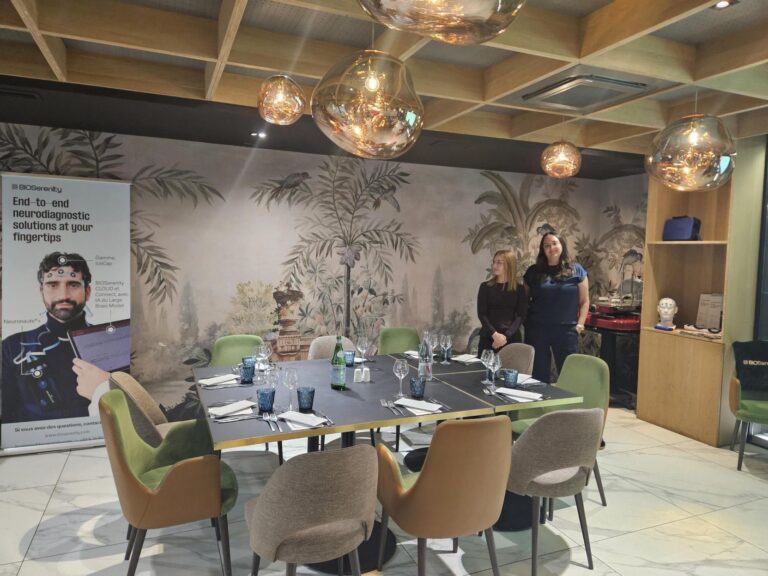
On Tuesday evening, the EPILOR network brought together around thirty health professionals in Nancy around the adult and pediatric brain, for a convivial evening of exchange and learning. This event illustrates a trend we’re increasingly seeing in the field: neurologists’ interest in long-term video EEG keeps growing, reflected in a rising number of exchanges and discussions on the topic. -

- Tech
•
- Expertise
BIOSerenity: a medtech compagny, proudly made in France, innovating for better healthcare
Published on:
August 26, 2026
Innovation in healthcare takes a strong ecosystem: talented people, medical expertise, and technology that turns ideas into solutions for patients. That’s the ecosystem we’ve built at BIOSerenity as a medtech made in France. We are proud to be a French MedTech company. We were founded in 2014 at the Institut du Cerveau et de la Moelle Épinière (ICM) at Pitié-Salpêtrière Hospital in Paris. Our mission has always been to combine medical expertise and technology to improve how patients are diagnosed and monitored. Our French roots remain central to who we are. -

- Tech
•
- Expertise
Spotlight on our healthcare professionals: when clinical expertise meets innovation
Published on:
July 24, 2026
In a sector where technological innovation is advancing rapidly, it is essential to remember that MedTech cannot be built without healthcare professionals. They are the ones on the ground who give technology its full meaning: ensuring the reliability of collected data, supporting patients with empathy, and bridging the gap between innovation and clinical reality. -
- Neurology
•
- Research & Innovation
Training EEG AI at Scale: Inside BIOSerenity’s Experiments on the Jean Zay Supercomputer
Published on:
July 10, 2026
What happens when cutting-edge supercomputing meets the challenge of understanding the human brain? Over the past three months, BIOSerenity has explored this question through large-scale EEG experiments on the Jean Zay system, one of France’s most powerful supercomputers, leveraging advanced computing and modern AI pretraining. At the core of this work are new large brain models designed to advance AI for neurophysiology and EEG analysis. As these models scale with more data, one question emerges: does bigger really mean better, or does brain data require a different approach? -
- Neurology
•
- Events
BioSerenity-E1 and its clinical applications presented in Grenoble at the Journées de Neurophysiologie Clinique
Published on:
July 6, 2026
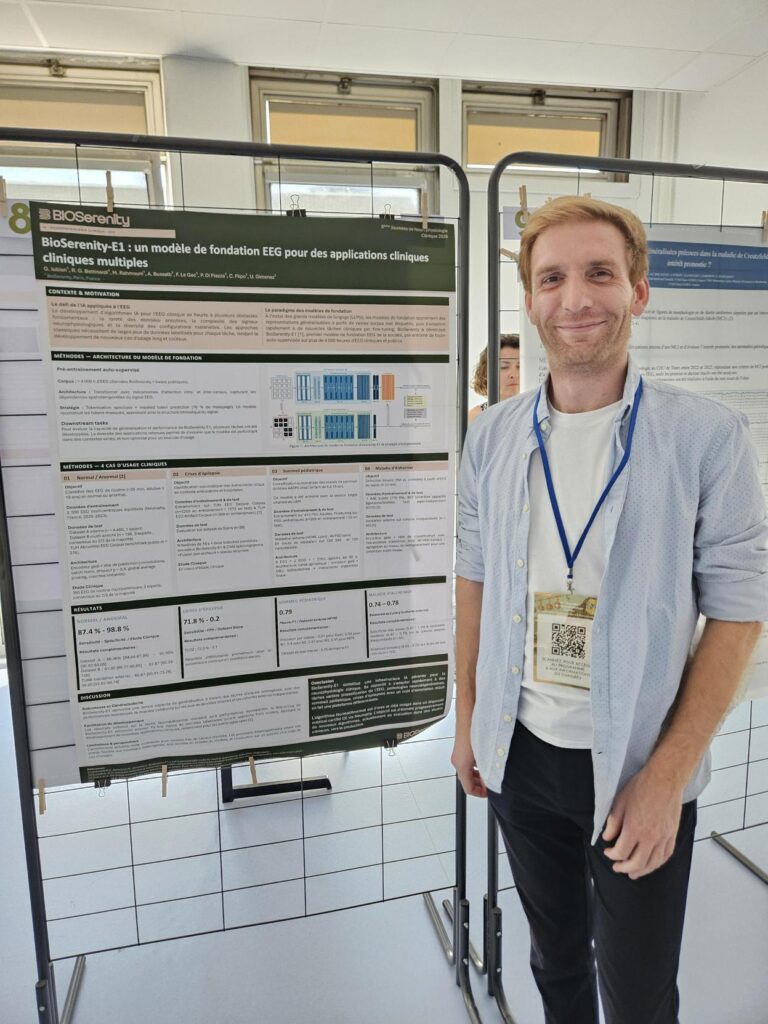
Guillaume Jubien presented a poster on the EEG foundation model BIOSerenity-E1 and its performance on four clinical tasks to an audience of clinicians and researchers during the 8th Journées de Neurophysiologie Clinique in Grenoble on June 24. -
- Neurology
•
- Research & Innovation
New poster accepted! Our work on BIOSerenity-E1 and its use in clinical cases will be presented at the Journées de Neurophysiologie Clinique!
Published on:
July 2, 2026
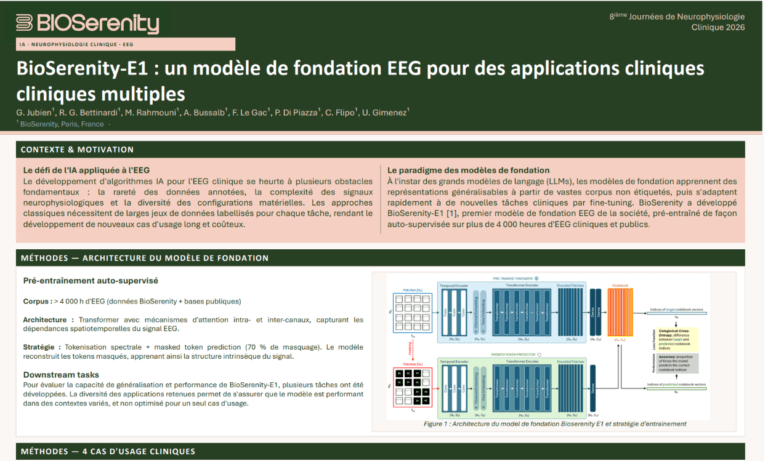
Our abstract “BIOSerenity-E1: a foundation EEG model for multiple clinical applications” has been accepted for a poster presentation at the 8th Journées de Neurophysiologie Clinique in Grenoble. This work highlights our research in the field of AI-assisted EEG analysis and the development of foundational models designed to support a wide range of applications in clinical neurophysiology.
1-6 of 15 results