


- Neurology
- Research & Innovation
- 2026
Training Large Brain Models for EEG Analysis on the Jean Zay Supercomputer
Author : Ruggero G. BETTINARDI, Mohamed RAHMOUNI, Antoine HONORÉ and Ulysse GIMENEZ
Estimated reading time: 8 minutes
BIOSerenity’s AI research team is using one of France’s most powerful supercomputers to pretrain and systematically scale up its Large Brain Models that read brain activity.
Are LBMs equal to LLMs ?
What happens when cutting-edge supercomputing meets the challenge of understanding the human brain? Over the past three months, BIOSerenity has explored this question through large-scale EEG experiments on the Jean Zay system, one of France’s most powerful supercomputers, leveraging advanced computing and modern AI pretraining.
At the core of this work are new large brain models designed to advance AI for neurophysiology and EEG analysis. As these models scale with more data, one question emerges: does bigger really mean better, or does brain data require a different approach?
Scaling Large Brain Models with Jean Zay
Over the past three months, BIOSerenity’s AI research team carried out one of the largest series of EEG-focused AI training experiments attempted to date, using Jean Zay, one of France’s most powerful supercomputers.
The goal: to pretrain and systematically scale up its Large Brain Models (LBM) built to interpret the brain’s electrical activity, and to understand, in a rigorous and controlled way, how these models behave as they grow.
The exercise was motivated by a question familiar to anyone following AI research: does bigger always mean better?
For AI systems trained on text, the answer has generally been yes: feed a model with more examples and greater capacity to learn, and it tends to perform better, following a well-documented recipe for balancing model size against the amount of training data1.
Whether the same holds true for AI trained on brain signals was far less certain, and testing it required building, and running, some of the largest EEG models BIOSerenity has trained to date.
The scale of this effort is worth noting
As one milestone, the team trained a prototype model with 300 million internal parameters on 110,000 hours of EEG recordings (equivalent to roughly six billion individual data points, known as “tokens”) running across 64 graphics processors of Jean Zay, the supercomputer operated by IDRIS, the CNRS’s national institute for scientific computing, and funded by GENCI as part of France’s strategy for sovereign AI research2,3.
For comparison, one of the best-performing EEG foundation model published so far has been trained on roughly half that data volumetry4, whereas most EEG foundation models published in the scientific literature have been trained on 2000 to roughly 30,000 hours of scalp EEG data5,6,7,8.
This 300M model training was kept short by design: it was intended to confirm that BIOSerenity’s data pipelines and computing infrastructure could reliably handle EEG data at this volume, before committing to longer, full-scale training runs.
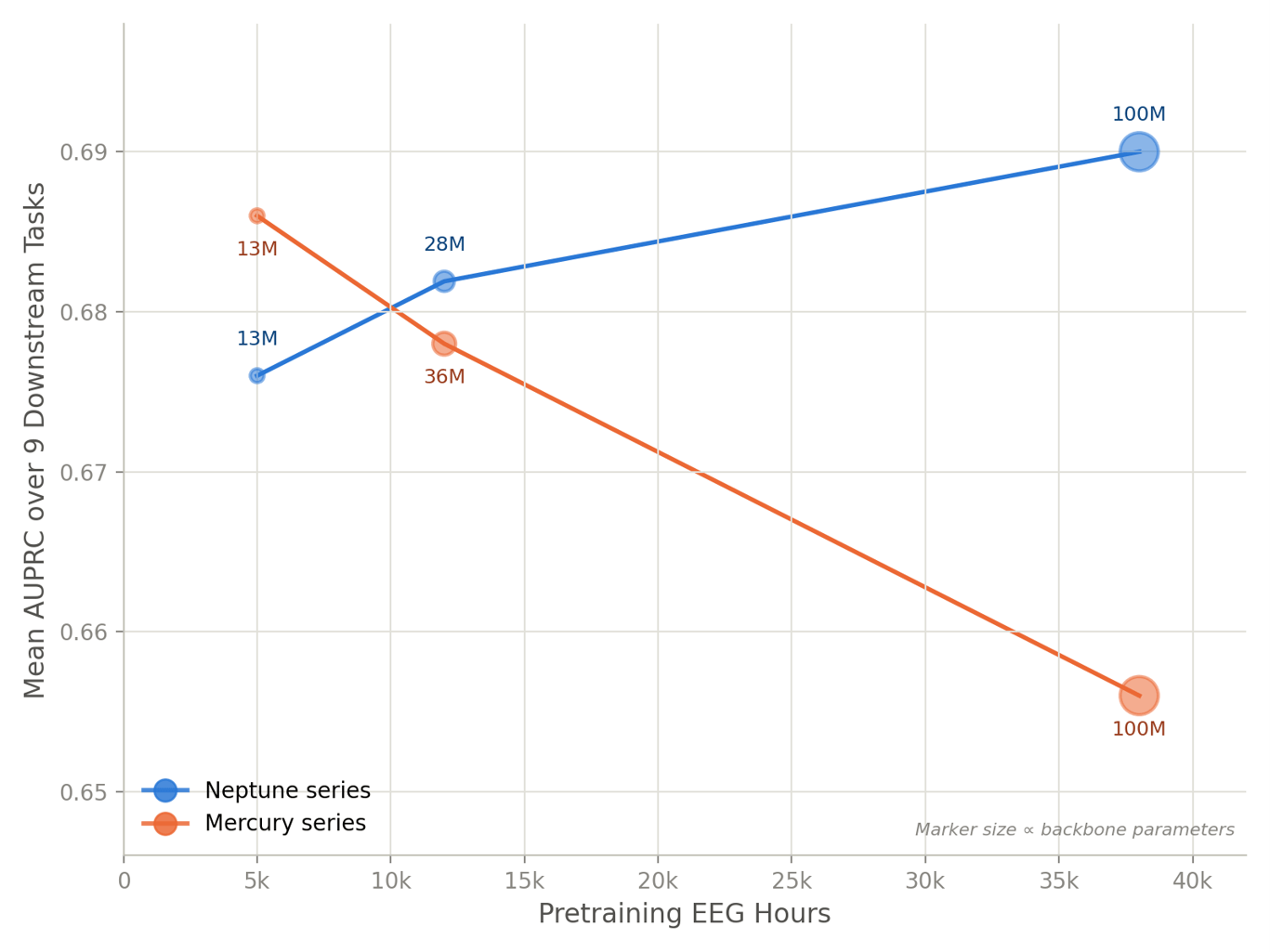
Mean AUPRC across 9 downstream tasks vs. pretraining EEG hours. The Neptune and Mercury series show opposite scaling trends. Marker size is proportional to model size.
With that capability confirmed, BIOSerenity then fully trained two separate families of EEG models (internally named Mercury and Neptune) at three sizes each, ranging from roughly 13 million to 100 million internal parameters, on progressively larger volumes of EEG data, from about 5,000 hours up to roughly 40,000 hours.
At every size, the amount of training data was scaled up in step with the model, following approximately the same 20-to-1 ratio between training data and model size that has proven effective for text-based AI1.
Each of the six resulting models was then evaluated on nine separate pathology-classification tasks drawn from five public EEG datasets, a mix of binary and multi-class problems spanning conditions such as Alzheimer’s disease, Parkinson’s disease, focal brain lesions, epilepsy, and encephalopathy, with every test repeated twice to guard against chance results.
The results split clearly in two directions
For the Neptune family, whose architecture is channel-agnostic, meaning it does not rely on knowing which scalp electrode each signal comes from, average accuracy improved as the model and its pretraining data grew, mirroring the pattern familiar from language AI.
For the Mercury family though, whose architecture does incorporate scalp channel information, the opposite occurred: its smallest version was its strongest performer, and accuracy declined as it was scaled up.
Both families were trained on identical recordings at matched sizes and evaluated the same way on the same random seeds, so the divergence cannot be explained by the raw material alone; something in how each architecture uses, or ignores, the spatial layout of the electrodes appears to interact differently with scale.
What can explain this behaviour ?
BIOSerenity’s AI research team is currently investigating the causes of this finding, which is not an isolated observation: a growing body of recent research on EEG foundation models has similarly reported that scaling benefits, when they appear at all, tend to be weaker, more inconsistent, or more architecture-dependent than the clean, predictable trends seen in large language models9. This will allow us to adapt all our architectures so that they can take full advantage of scaling.
Understanding when, and why, brain-signal AI scales differently from language AI is an active and genuinely exciting area of ongoing research, one BIOSerenity is contributing to.
These findings come from BIOSerenity’s own internal experiments and have not yet been peer-reviewed or published; they are shared here as a transparent, in-progress account of the latest research made by the AI research team.
Our research at BIOSerenity continues
Running experiments at this scale, spanning multiple model families, sizes, and data volumes, and requiring the resources of a national supercomputer, is not a one-off exercise for BIOSerenity.
It reflects how the company approaches the development of clinical-grade EEG AI more broadly: systematically, at scale, and with a willingness to report findings that complicate simple narratives rather than only the ones that confirm them.
Because these models are ultimately intended to operate as medical devices in sensitive clinical situations, they must meet the highest possible standards. That can only be achieved by continuously challenging them and digging deeper into how these sophisticated systems operate.
BIOSerenity’s AI research teams is continuing this line of work, using the same national computing infrastructure to push EEG foundation models further and to better understand where, and why, brain-wave AI parts ways with the rules that govern its language-based cousins.
Acknowledgments
BIOSerenity thanks the Jean Zay ecosystem – IDRIS (Institut du Développement et des Ressources en Informatique Scientifique, CNRS) and GENCI (Grand Équipement National de Calcul Intensif) – for providing access to the Jean Zay supercomputer and for their technical support throughout this work, carried out as part of France’s national strategy for sovereign AI research.
References
1. Hoffmann, J., Borgeaud, S., Mensch, A., Buchatskaya, E., Cai, T., Rutherford, E., de Las Casas, D., Hendricks, L. A., Welbl, J., Clark, A., Hennigan, T., Noland, E., Millican, K., van den Driessche, G., Damoc, B., Guy, A., Osindero, S., Simonyan, K., Elsen, E., Rae, J. W., Vinyals, O., & Sifre, L. (2022). Training compute-optimal large language models. arXiv. https://doi.org/10.48550/arXiv.2203.15556
2. Centre National de la Recherche Scientifique. (2024, March 28). GENCI and CNRS choose Eviden to make the Jean Zay supercomputer one of the most powerful in France. CNRS News. https://www.cnrs.fr/en/press/genci-and-cnrs-choose-eviden-make-jean-zay-supercomputer-one-most-powerful-france
3. Grand Équipement National de Calcul Intensif. (2021). A new partition dedicated to AI for the Jean Zay supercomputer. GENCI News. https://www.genci.fr/en/news/new-partition-dedicated-ai-jean-zay-supercomputer
4. El Ouahidi, Y., Lys, J., Thölke, P., Farrugia, N., Pasdeloup, B., Gripon, V., Jerbi, K., & Lioi, G. (2025). REVE: A foundation model for EEG—Adapting to any setup with large-scale pretraining on 25,000 subjects. Advances in Neural Information Processing Systems.
5. Cui, M., Chen, T., Jiao, Y., Wang, Y., Xie, L., Pan, Y., & Mainardi, L. (2026). BrainRVQ: A high-fidelity EEG foundation model via dual-domain residual quantization and hierarchical autoregression. arXiv. https://arxiv.org/abs/2602.16951
6. Wang, C., et al. (2024). CBraMod: A criss-cross brain foundation model for EEG decoding. arXiv. https://arxiv.org/abs/2412.07236
7. Jiang, W.-B., Zhao, L.-M., & Lu, B.-L. (2024). Large brain model for learning generic representations with tremendous EEG data in BCI. In The Twelfth International Conference on Learning Representations (ICLR 2024). arXiv. https://arxiv.org/abs/2405.18765
8. Döner, B., Ingolfsson, T. M., Benini, L., & Li, Y. (2025). LUNA: Efficient and topology-agnostic foundation model for EEG signal analysis. In Advances in Neural Information Processing Systems (NeurIPS 2025). arXiv. https://arxiv.org/abs/2510.22257
9. Kuruppu, G., Wagh, N., & Varatharajah, Y. (2025). EEG foundation models: A critical review of current progress and future directions. Foundation Models for the Brain and Body Workshop, 39th Conference on Neural Information Processing Systems (NeurIPS 2025). https://openreview.net/forum?id=Iu6qVgtgUD
Note: Mercury and Neptune scaling results reported above reflect BIOSerenity’s own internal research (2026), conducted on the Jean Zay supercomputer. They are preliminary and have not undergone external peer review.